AI SDR vs Human SDR: Costs, Strengths and Best Use Cases
Posted On: June 23, 2026
Last updated: August 2026 · Written by Seth Ayush, Co-Founder of AI Workforce
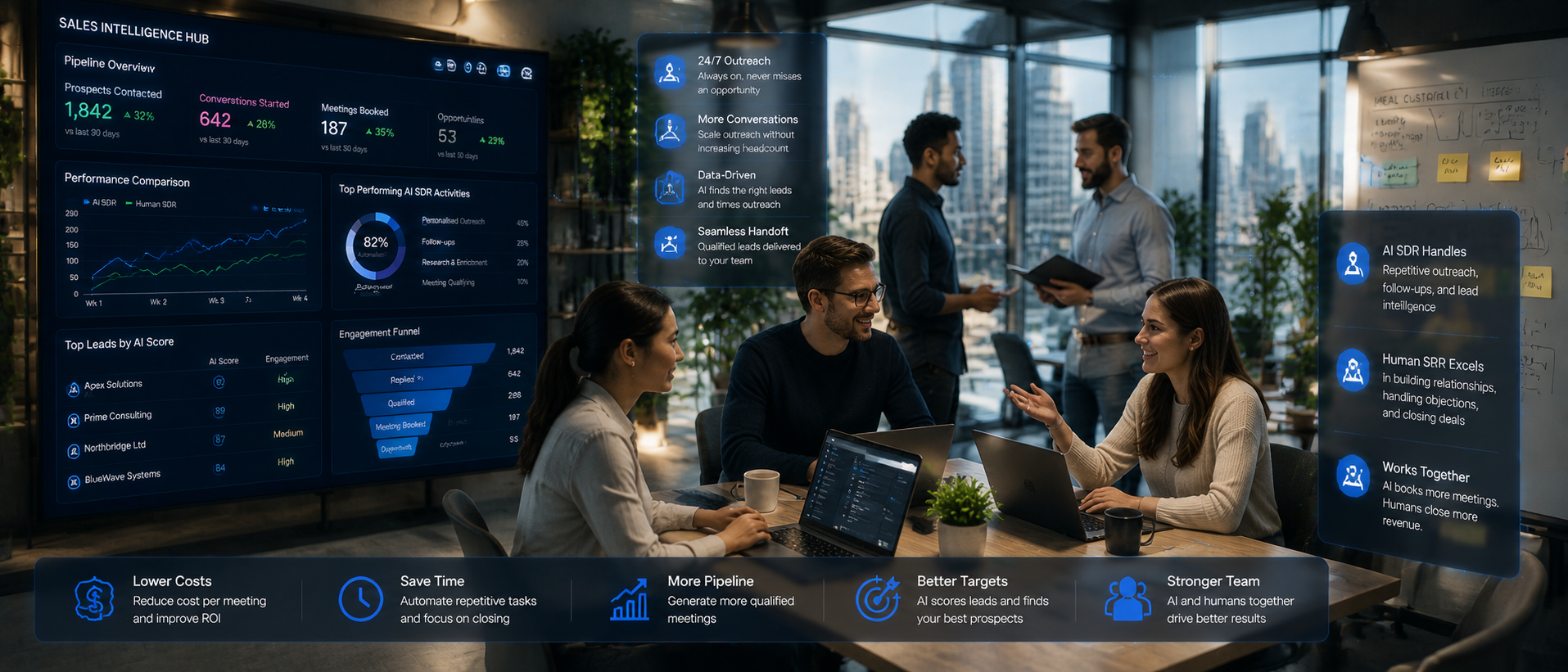
AI SDRs can research accounts, support outreach, classify responses and move qualified conversations into a human sales workflow. Human SDRs remain stronger where qualification depends on judgement, nuanced discovery and relationship building. The practical question is not which one should replace the other, but which tasks should be automated, which should remain human-led, and how the results should be measured.
Quick Answer
An AI SDR is software that automates part of the early sales pipeline, typically account research, outreach drafting or sending, reply classification and structured qualification, depending on the platform. A human SDR handles the same broad function through judgement, discovery conversations and relationship building. For many sales teams, a practical starting model is AI supporting the high-volume, structured layer of prospecting while people handle nuanced qualification, senior stakeholders and anything that does not follow a predictable pattern. The performance of that model should still be validated against the team's own pipeline data.
At a Glance
What it is: software that automates part of prospecting, outreach, reply handling and qualification, working alongside a human sales team
Best suited to: high-volume outbound, inbound response and structured qualification criteria
Biggest benefit: additional research and outreach capacity without a proportional increase in headcount
Biggest risk: incorrect research, weak personalisation, deliverability damage or a compliance failure running unchecked at scale
Human SDRs still lead on: senior stakeholders, nuanced discovery, objection handling and multi-thread account relationships
AI SDR vs Human SDR at a Glance
AI SDRs and human SDRs perform overlapping parts of the sales-development role, but they are strongest at different types of work. AI is better suited to structured, repetitive activity that benefits from speed and consistency, while people remain stronger where qualification, objection handling and account development depend on judgement. The comparison below shows the practical difference before we look at each area in more detail.
Area | AI SDR | Human SDR |
|---|---|---|
Prospect research | Fast across large account volumes | Slower, but stronger on ambiguous context |
Outreach volume | High and consistent | Limited by individual capacity |
Personalisation | Scalable from structured data | Strongest for bespoke, strategic messaging |
Follow-up | Reliable against defined rules | Can adapt timing and tone more freely |
Qualification | Strong with explicit criteria | Stronger for nuanced discovery |
Objection handling | Best for anticipated scenarios | Stronger for unusual or sensitive objections |
Senior stakeholders | Better as a support layer | Stronger for relationship-led engagement |
Availability | Can operate beyond office hours | Limited by working patterns |
Scaling | Usage and infrastructure | Hiring and onboarding |
Main risk | Errors can repeat at scale | Inconsistency and capacity constraints |
Oversight | Monitoring, rules and escalation | Coaching and management |
Neither model is universally better. A high-volume sales motion with repeatable qualification criteria may benefit from more AI-led execution, while complex, high-value or multi-stakeholder sales usually require greater human involvement. For many teams, the practical question is therefore how to divide the work rather than which side should replace the other.
What's Covered
Strengths and Risks
Cost and Compliance
Putting It Into Practice
What Is an AI SDR?
A sales development representative manages the early pipeline: prospecting, outreach, follow-up and qualification, before a conversation is handed to an account executive or closer. An AI SDR is software that automates some or all of this layer using workflow automation and language models, rather than a person working the sequence manually.
"AI SDR" is a broad commercial label rather than one standard product category. Depending on the platform, it may research accounts, enrich contact and company data, draft or send multichannel outreach, classify replies, ask basic qualification questions, update a CRM, or book meetings. Some tools marketed as an AI SDR are closer to a message-generation assistant. Others are workflow automations built around a specific channel, or a voice agent handling inbound calls. Some newer AI SDR systems also extend beyond written outreach into voice conversations, where an AI agent can qualify interest, answer initial questions and route suitable opportunities to a human salesperson. Buyers should assess the actual workflow a platform performs rather than assume every AI SDR does all of the above.
If you're comparing actual platforms, our AI SDR Tools 2026 guide compares AiSDR, Artisan, Regie.ai, Reply.io, Salesforge and 11x across prospecting, outreach channels, qualification, meeting booking, CRM integration, pricing and human oversight.
The SDR role is not disappearing. Its early, high-volume layer is increasingly handled by software, while the discovery and relationship-building layer remains human-led.
What Does a Human SDR Do?
A human SDR runs the same early-pipeline function through direct conversation and judgement: researching an account, reaching out, handling objections, asking discovery questions, and deciding whether an opportunity is genuinely worth passing to an account executive. Human SDRs remain particularly valuable when qualification requires nuanced discovery, careful objection handling, account mapping across multiple stakeholders, or engagement with senior decision-makers.
It is worth being precise about where the SDR function ends. An SDR typically qualifies a lead and creates an opportunity; an account executive or closer usually owns the later deal stages, negotiation and close. An SDR may still help multi-thread or nurture an account over time, but closing enterprise deals is not normally the defining SDR function, and comparing AI against a human SDR should stay focused on sales development work rather than the whole sales cycle.
How the Work Divides Between AI and Human SDRs
Prospect research: AI is faster at structured, high-volume research; people are better at interpreting ambiguous or conflicting context
Message drafting: AI scales quickly and applies a consistent format; people are stronger at bespoke, strategic communication for a specific stakeholder
Follow-up cadence: AI is reliable once a workflow is correctly configured; people adapt cadence using judgement about how a specific prospect is responding
Qualification: AI is effective against clear, structured criteria; people are stronger where discovery is genuinely nuanced
Objection handling: AI can handle anticipated, scripted responses; people are better placed for unusual or sensitive objections
Account relationships: AI has limited ability to build relationships without human involvement; people build genuine trust and multi-thread contacts within an account
Availability: AI can operate beyond office hours and across time zones; people are limited by working patterns
Scaling: AI scales through usage and infrastructure; scaling people requires hiring and onboarding
Risk profile: AI can repeat a data or messaging error at volume before anyone notices; people can be inconsistent or capacity-constrained
Oversight needed: AI needs monitoring, approved boundaries and a review process; people need coaching and performance management
What AI SDRs Handle Well at Scale
Where platforms are configured correctly, AI SDRs tend to do well at the structured, repeatable layer of prospecting. They can respond to inbound leads quickly, run outreach sequences across a large number of accounts, and apply a consistent structure, tone and cadence across every touchpoint, though the underlying quality of that output still depends on the data, instructions, approval rules and how closely it is reviewed.
Where suitable data sources and integrations are connected, an AI SDR may use signals such as company announcements, role changes, CRM history or previous engagement to inform outreach. The freshness and accuracy of those signals varies by provider and data source, and is worth checking rather than assuming, since "live" data can still be stale or come from a licensed third-party feed rather than genuine real-time monitoring.
AI SDRs can also operate outside standard hours and across time zones without being constrained by human working hours, although throughput still depends on platform capacity, usage limits and infrastructure. That is a genuine structural advantage for covering overnight inquiries, weekend leads and high-volume campaigns that would otherwise sit unattended. That coverage can help a lean team reach segments it would otherwise miss, and the account research an AI SDR produces before a conversation reaches a human rep can give that rep a sharper starting point. For example, an AI SDR workflow can combine company research, contact enrichment, personalised outreach and qualification steps into one repeatable process, allowing a sales team to focus on conversations that require human involvement.
AI Workforce Insight: In our experience building outreach and workflow agents, the hardest part was not generating messages. It was building reliable decision logic: knowing when a reply represented genuine buying intent, when it required clarification, and when it should immediately move to a person. Getting that logic right mattered more to overall quality than making any individual message sound more polished.
Illustrative workflow. Approval rules and escalation thresholds should be set before any of this runs unattended.
Where AI SDRs Can Go Wrong
A trustworthy comparison has to be honest about failure modes, not just capability. Current AI SDR platforms can still:
Research the wrong person or company, particularly with common names or similar company titles
Generate personalisation based on an inaccurate or outdated signal
Send outreach to a contact who has already opted out or unsubscribed
Treat a polite decline or an objection as genuine interest
Book a meeting with a contact who does not actually meet the qualification criteria
Miss sarcasm, sensitivity or a distressed tone in a reply
Repeat the same message across multiple contacts at one account
Damage sender or domain reputation through excessive volume or poor list hygiene
Update CRM fields incorrectly or duplicate existing records
Continue a scripted sequence in a situation that calls for stopping and escalating
Optimise for reply volume rather than the quality of the resulting pipeline
None of this makes an AI SDR unsuitable for high-volume prospecting. It does mean a tested fallback, approved data sources, suppression-list checks and a genuine human review step matter more than the headline personalisation quality of any single message.
Illustrative summary. Your own data quality and review process still determine which side of this list you land on.
Where Human SDRs Add the Most Value
Human SDRs still lead where deals get genuinely complex. Senior stakeholders, multi-stakeholder accounts, and sensitive or unusual conversations all benefit from judgement that current AI systems do not consistently provide across unusual or sensitive situations. When a prospect raises an unexpected objection, changes tone, or signals that a deal is going cold, a skilled rep can adapt in the moment in a way a scripted workflow cannot.
Human SDRs build multi-thread relationships inside an account over time, not just a sequence of automated touchpoints, and that groundwork is often what supports referrals, renewals and long-term trust later in the relationship. Human involvement is likely to add the most value specifically where qualification depends on nuanced discovery, trust, contextual judgement or an unusual buying process, though the actual effect on your own conversion and progression rates is worth measuring rather than assuming.
How Do AI and Human SDRs Compare on Cost?
Cost comparisons in this space are often oversimplified in both directions. A useful way to think about it is by cost area rather than a single headline number:
Core cost: a human SDR's cost sits in salary and employer costs; an AI SDR's cost sits mainly in software subscriptions and usage
Setup cost: a human hire needs recruitment and onboarding; an AI SDR needs workflow design, data connections and integration work
Scaling cost: scaling a human team needs additional hiring; scaling AI needs additional usage, infrastructure and review capacity, which is not free even though it avoids headcount
Ongoing management: a person needs coaching and performance management; an AI SDR needs monitoring, prompt or workflow maintenance and periodic evaluation
Failure cost: a person's failure mode is usually inconsistency or limited capacity; an AI SDR's failure mode can include poor data, brand damage or deliverability problems at volume
What to actually compare: cost per accepted meeting or qualified opportunity, not subscription price against salary
For a UK cost benchmark, our dedicated AI SDR pricing guide models the full cost stack separately, including salary, commission, employer costs, sales tools, recruitment, management time, AI platform fees, data and infrastructure. The important comparison is total operating cost against held qualified meetings and pipeline created, rather than comparing a software subscription with a base salary in isolation.
Illustrative comparison. Actual costs on both sides depend on your provider, scale and the review process you keep in place.
An AI SDR can reduce the marginal cost of researching, drafting and processing additional prospects, but the full operating cost includes the platform, data and enrichment fees, sending infrastructure, mailboxes and domains, integrations, implementation and the human review time needed to keep it accurate. Software costing less than a full-time salary is not automatically equivalent to the output of several productive human reps. Our dedicated AI automation pricing guide breaks down typical UK build and running costs for workflow and AI agent projects in more depth.
Compliance and Deliverability Considerations
Automated prospecting still has to work within the same UK data protection and marketing rules that apply to any outbound activity, whether a person or a platform sends the message.
For UK operations, electronic marketing to individual subscribers is governed by PECR. Marketing emails or texts generally require consent unless the soft opt-in applies, for example where the person bought or entered discussions to buy a similar product or service from you, you collected their details in that context, and you offered a clear opt-out both at collection and in every subsequent message. The soft opt-in does not generally cover new prospects obtained from bought-in lists. Corporate bodies can generally be emailed without the same consent requirement, though it remains good practice to maintain a do-not-contact list for any business that objects, and sole traders and some partnerships are treated as individuals rather than corporate bodies for this purpose. UK GDPR still applies when a named business contact's personal data is used, and that individual retains an absolute right to object to direct marketing.
Individuals also have an absolute right under UK GDPR to object to their data being used for direct marketing at any time, and you must stop processing their data for that purpose as soon as a valid objection is received, generally by suppressing rather than necessarily deleting their record. Where a lawful basis such as legitimate interests is relied on for prospecting activity, it is worth documenting a legitimate interests assessment rather than assuming the basis applies by default.
Before scaling any automated outreach, it is worth checking:
The lawful basis you are relying on for each type of contact, and whether a legitimate interests assessment has actually been documented
Whether recipients are individuals, sole traders or corporate bodies, since the rules differ
That opt-outs and unsubscribes are captured and screened against before every send, not just at sign-up
That the sender identity is clear and not disguised, with a valid way to reply or unsubscribe
Whether outbound calls are involved, since live and automated calls are regulated differently under PECR from email or text
Data-source transparency: where enrichment or research data actually comes from, and how current it is
The terms of service for any platform used for outreach, such as LinkedIn or other messaging platforms
CRM access permissions for the AI SDR tool itself, kept to what the workflow genuinely needs
A human approval step for higher-risk or higher-value messaging rather than fully automated sending in every case
Deliverability controls. Sending volume and reputation deserve their own attention alongside the legal checklist above:
Appropriately managed and, where relevant, separate sending infrastructure
Gradual increases in sending volume rather than a sudden jump
Proper email authentication configured for your sending domains
Ongoing bounce and complaint-rate monitoring
A working suppression process, checked every send before
Avoiding sudden, large changes in volume or targeting that can affect inbox placement
If email is the main channel in your AI SDR workflow, our guide to the best cold email software compares dedicated platforms on deliverability, sending infrastructure, personalisation, pricing and UK compliance.
None of these guarantee inbox placement on their own; they reduce risk rather than eliminate it, and deliverability still depends on the receiving mailbox provider's own filtering.
Compliance note: this is general information, not legal advice. Take specific advice on your own outreach practices and check current ICO guidance, which continues to develop in this area.
The Hybrid Operating Model
A practical operating model is to treat AI and human SDRs as covering different layers of the same pipeline, rather than competing for exactly the same work. For teams that want AI to support individual reps without independently running prospecting and outreach, our Best AI Sales Assistant Software comparison covers lower-autonomy copilot tools for meeting preparation, call summaries, follow-up drafting, CRM updates and next-action recommendations. A practical hybrid workflow looks roughly like this:
AI identifies and scores accounts against defined criteria
AI gathers approved research signals from connected data sources
AI drafts or sends low-risk initial outreach within agreed rules
AI classifies responses and captures structured details
A person reviews uncertain, sensitive or high-value conversations and takes over deeper qualification
The person determines whether the lead should become a sales-accepted opportunity
Qualified opportunities pass to the appropriate account executive or closer
Outcomes feed back into qualification, targeting and escalation rules
Feeding outcomes back into the workflow over time means the system improves with use rather than running unchanged indefinitely. The strongest operating model for many teams is likely to combine AI-supported research and workflow execution with human judgement, although the actual result depends on your data quality, process design, market and how performance is measured, rather than being a guaranteed outcome of adopting the tools.
Industry survey data points in a similar direction without settling the question outright. Salesforce's 2026 State of Sales survey reports that 88% of sales professionals using agents believe AI increases their odds of hitting sales targets, while high-performing teams were 1.7 times more likely than underperformers to use prospecting agents specifically. This is vendor-reported survey evidence showing perception and association, rather than proof that AI caused the performance difference. McKinsey describes selected financial-services organisations that rebuilt prospecting and relationship-management workflows around agentic AI and reported higher revenue per relationship manager and lower cost-to-serve, while also noting that fewer than 10% of organisations have scaled AI in any individual function. Treat these as evidence of potential rather than a typical, guaranteed result, and as directional evidence that supports piloting the approach rather than proof that a hybrid model will outperform in every business.
How to Measure Whether Your Approach Is Working
Meetings booked alone are not a sufficient measure, since a platform can produce a high volume of meetings while lowering their quality. Track a broader mix of volume, quality and risk indicators:
Valid-contact rate and deliverability or bounce rate
Positive-reply rate, separate from total reply volume
Opt-out and complaint rate
Qualification accuracy, checked against what actually turns into a real opportunity
Accepted-meeting rate and meeting attendance rate
Sales-accepted opportunity rate and pipeline generated
Conversion rate by source, comparing AI-originated and human-originated activity
Cost per accepted opportunity, not cost per message sent
Human correction rate and incorrect-personalisation rate
CRM-write error rate
Time saved per representative, measured against a real baseline rather than assumed
Review these over several weeks of real activity before deciding whether to expand an AI SDR to a new segment or channel.
Illustrative roadmap. Pace depends on your data quality, segment complexity and how much evaluation the use case warrants.
Is an AI SDR Right for Your Business?
A rough guide to fit: an AI SDR is generally a good starting candidate where you have a meaningful volume of similar accounts to prospect, clear and structured qualification criteria, and a defined rule for when a conversation needs a person instead. It is a weaker fit, or at least needs closer human oversight, where your buying process routinely involves senior stakeholders, long or unusual sales cycles, or highly regulated, relationship-driven selling.
For businesses already using AI agents elsewhere in the organisation, our guide to AI agents for small businesses covers the broader landscape of where these systems add value, and our guide on how to write an AI agent brief covers how to scope permissions, escalation and evaluation properly before deploying one for outreach specifically. Where prospecting extends into calls rather than written outreach, our AI voice agents guide covers how that technology works and what to check before it speaks to a real prospect. Our digital workforce guide covers the wider question of how automation, AI and people should divide labour across a business, which is the same underlying question this article answers for sales development specifically.
Frequently Asked Questions
Will an AI SDR replace my human SDR team?
Not entirely, for most businesses. AI SDRs can take on a meaningful share of high-volume, structured prospecting work, but people remain stronger for nuanced qualification, senior stakeholders and relationship building. Most teams get the best results from dividing the work rather than choosing one over the other.
Is an AI SDR the same thing across every vendor?
No. "AI SDR" is a broad label covering research tools, message-generation assistants, workflow automations and voice agents. Check what a specific platform actually does, rather than assuming it covers the full sales development function.
Does an AI SDR cost less than a human SDR?
Software typically costs less than a full-time salary and employer costs, but the full cost of an AI SDR includes data, sending infrastructure, integrations and human review time. Compare cost per accepted opportunity rather than subscription price against salary alone.
Do UK GDPR and PECR apply to AI-generated outreach?
Yes. The same marketing and data protection rules apply regardless of whether a person or a platform sends the message. Check your lawful basis, whether recipients are individuals or corporate bodies, and that opt-outs are captured and respected before every send.
What is the biggest risk of an AI SDR running unsupervised?
Errors compounding at volume before anyone notices, incorrect personalisation, contacting someone who opted out, or damaging sender reputation through poor list hygiene. A human review step for uncertain or high-value conversations reduces this risk considerably.
How do I know if a hybrid model is working?
Track qualification accuracy, accepted-meeting and opportunity rates, cost per accepted opportunity, and complaint or opt-out rate, over several weeks of real activity, rather than judging by reply or meeting volume alone.
Can an AI SDR make phone calls?
Some AI SDR platforms extend into voice outreach, allowing AI agents to conduct initial qualification calls, answer basic questions and schedule follow-ups. Voice outreach introduces additional considerations around consent, disclosure and call regulations, so it is worth treating separately from email-based prospecting rather than assuming the same rules apply.
Key Takeaways
"AI SDR" is a broad commercial label; check what a specific platform actually does before assuming it covers research, outreach, qualification and CRM updates all at once
AI SDRs tend to do well at structured, high-volume prospecting, consistent cadence and after-hours coverage, provided the underlying data and rules are properly maintained
AI SDRs can still fail in specific ways: incorrect research, weak personalisation, contacting opted-out prospects, or damaging deliverability at volume
Human SDRs remain stronger for nuanced qualification, senior stakeholders, unusual objections and multi-thread account relationships
Compare AI and human SDR cost by cost per accepted opportunity, not subscription price against salary alone
UK GDPR and PECR apply to AI-generated outreach in the same way they apply to human-sent messages
A hybrid model that combines AI-supported research and execution with human judgement is a reasonable starting point for many teams, though the result should be validated against your own pipeline and conversion data rather than assumed
Track qualification accuracy, opportunity and conversion rates, and cost per accepted opportunity, not meetings booked alone
See If a Hybrid AI and Human SDR Model Fits Your Business
Book a free AI readiness assessment. We will look at your current pipeline, qualification criteria and outreach workflows to identify where AI-supported prospecting can genuinely add capacity without adding compliance or data-quality risk.
About the Author
Seth Ayush is Co-Founder of AI Workforce, a British AI company building AI agents for UK businesses. He works on how AI Workforce's outreach and workflow agents are designed, tested and deployed, with a focus on getting reply handling and escalation logic right before a system is trusted with real prospects.
Reviewed: August 2026