
AI in Healthcare UK: How the NHS Uses AI Safely
Posted On: August 1, 2026
Written by Seth Ayush, Co-Founder of AI Workforce · Reviewed by Luca Controlo, AI Adoption and Marketing Automation Lead at AI Workforce
Last updated: August 2026
Healthcare is different from most other sectors this guide covers. A wrong AI-drafted email is an inconvenience. A wrong AI-influenced clinical decision can harm a patient. That distinction shapes everything below: what AI can usefully do in a UK healthcare setting, what NHS England is actually rolling out right now, how the MHRA regulates AI as a medical device, what UK GDPR requires for patient health data, and where clinical judgement must remain firmly in human hands.
Quick Answer: AI in healthcare covers tools that support clinical documentation, triage, diagnosis, research and administration, ranging from an ambient scribe that drafts a consultation note to an imaging tool that flags a scan for closer review. In the UK, AI supports clinical work; it does not automatically inherit clinical responsibility. Software with a medical purpose may be regulated by the MHRA as a medical device, patient health data is special category data under UK GDPR, and a clinician remains accountable for diagnosis, treatment and prioritisation decisions.
At a Glance
What it is: AI tools used across clinical documentation, diagnosis support, triage, administration and research in health and care settings
Where AI helps most: transcription and note drafting, imaging flags for a specialist to review, structuring information, administrative scheduling and population-level research
What should stay clinician-led: diagnosis, treatment decisions, prescribing, clinical prioritisation and any decision materially affecting patient care
Biggest risk: treating an AI-generated flag, summary or triage suggestion as a finished clinical judgement rather than an input a qualified person reviews
Regulatory anchor: MHRA medical-device regulation, NHS governance, and UK GDPR's special category data rules, not the EU AI Act or the US FDA
What's Covered
1. What Is AI in Healthcare? | 14. Worked Example: Patient Appointment to Clinical Record |
2. Clinical vs Non-Clinical AI in Healthcare | 15. What Should Never Be Left to AI Alone? |
3. How Is AI Being Used in the NHS in 2026? | 16. When Is Healthcare AI a Medical Device, and How Does the MHRA Regulate It? |
4. The AI Workforce Healthcare AI Model | 17. UK GDPR and Patient Health Data |
5. What Can Healthcare AI Actually Automate? | 18. Bias, Validation and Clinical Safety |
6. The AI Workforce Healthcare AI Boundary Matrix | 19. How Should a Healthcare Organisation Assess an AI Vendor? |
7. AI for Clinical Documentation and Administration | 20. How to Measure Healthcare AI |
8. AI for Diagnosis and Medical Imaging | 21. Benefits and Limitations |
9. AI for Triage and Patient Communication | 22. Common Mistakes |
10. AI for Research and Population Health | 23. A Four-Week Pilot Framework |
11. Where Can AI Help Without Making Clinical Decisions? | 24. Related Guides |
12. How Can AI Receptionists Support Healthcare Providers? | 25. Frequently Asked Questions |
13. AI for Private Medical, Dental and Allied-Health Practices | 26. Key Takeaways |
What Is AI in Healthcare?
AI in healthcare covers a wide range of tools, from a simple rules-based scheduling system to a machine learning model trained to flag patterns in a scan. What they share is a role supporting a person's work rather than replacing their judgement. An AI tool can structure information, surface a pattern, draft a document or triage an enquiry faster than a person working alone. It should not be the final word on a diagnosis, a treatment or a safety-critical decision.
The performance of a healthcare AI system depends heavily on the quality, representativeness and relevance of the data used to develop and validate it. A model that performs well on one population or clinical setting may not necessarily perform equally well elsewhere. This is why UK healthcare organisations are increasingly cautious about a tool's evidence base, not just its headline accuracy claim.
How is AI used in healthcare? AI is used in UK healthcare for clinical documentation and ambient note-taking, triage support in primary and urgent care, flagging areas of concern on medical images for a specialist to review, administrative scheduling, and research across large patient datasets. A clinician or other qualified professional remains responsible for diagnosis, treatment and prioritisation decisions.
Clinical vs Non-Clinical AI in Healthcare
Whether a task is treated as high risk depends on the system's intended purpose and use, not simply whether it happens to sit inside a healthcare organisation. A scheduling tool used by a clinic is not automatically a medical device. Software that provides information used for diagnosis or treatment may be regulated as one, regardless of how simple its interface looks.
Non-clinical AI supports the business of running a healthcare service: bookings, reminders, correspondence, staff scheduling and administrative document handling. Clinical AI touches diagnosis, treatment, prescribing or triage logic that influences care. The two categories carry very different regulatory, data-protection and safety obligations, and a useful first step for any organisation is sorting a proposed tool into one category or the other before evaluating it further.
How Is AI Being Used in the NHS in 2026?
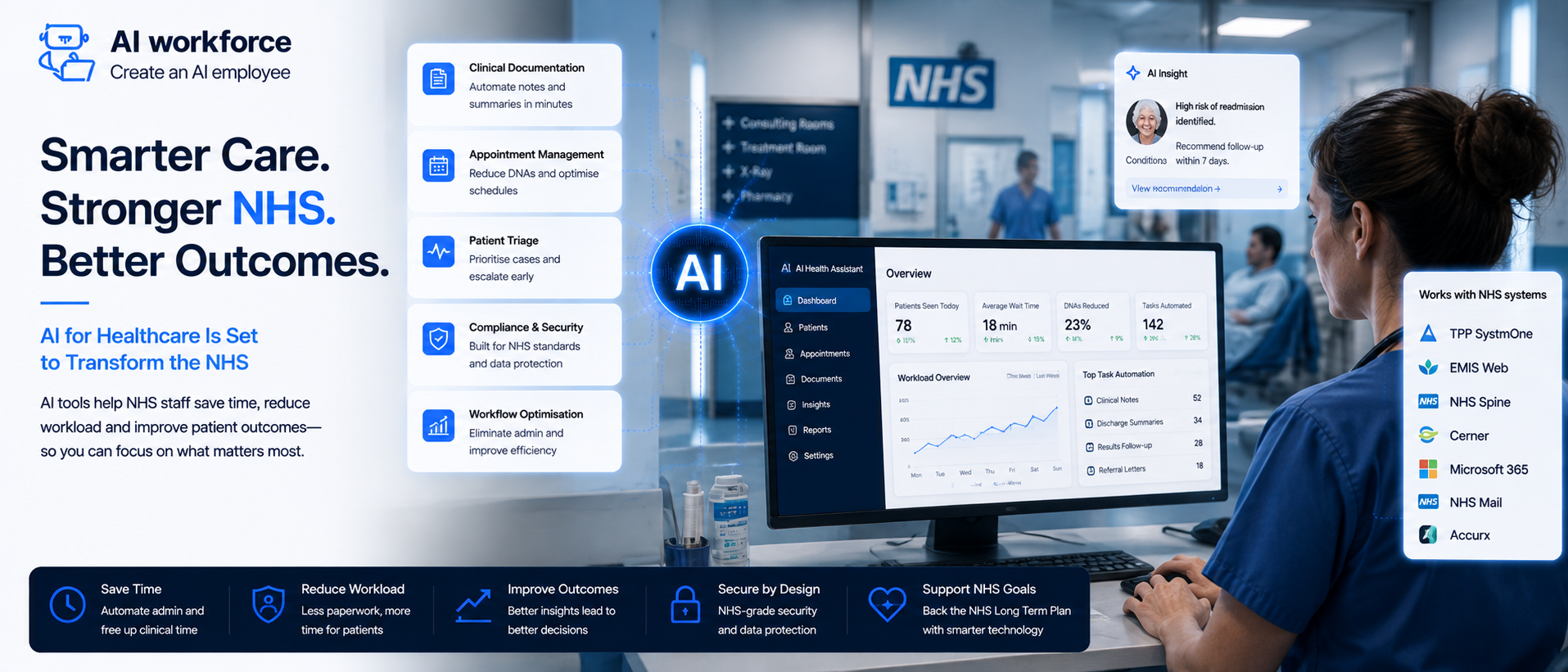
AI in UK healthcare is moving from local pilots and existing deployments into wider NHS adoption, particularly in administration, documentation, triage support and selected diagnostic workflows. On 4 July 2026, NHS England announced it is accelerating a rollout of AI tools as part of a £10 billion technology, digital and data investment over three years, expected to deliver around half of the commitments in the government's 10 Year Health Plan and generate an estimated £41 billion in benefits over the next decade.
Can the NHS use AI? Yes. NHS England's own July 2026 announcement confirms a national rollout of AI tools including an AI triage tool in the NHS App and wider access to AI notetaking (ambient voice technology) for clinical staff, backed by government funding and NHS England governance rather than informal local adoption alone.
Two developments sit at the centre of the July 2026 announcement:
AI triage in the NHS App. Following a successful trial at a GP practice in Sussex, which cut phone queueing by 29%, the tool is being rolled out to reach more than 200,000 patients within 12 months and all NHS App users by April 2028. It asks adaptive questions based on a patient's responses, then directs them to the most appropriate service, a GP appointment, pharmacy, A&E, community service or self-care advice, or provides clinicians with information to prioritise care. Patients can still contact their practice through traditional routes. Source: NHS England, 4 July 2026 press release.
AI notetaking and ambient voice technology. NHS England is supporting a national rollout of tools that record patient-staff conversations to generate real-time transcriptions and clinical summaries, starting with hospital appointments that do not require an overnight stay. A study led by Great Ormond Street Hospital found that ambient voice technology frees up clinicians to spend nearly a quarter more of their time with patients; scaling it to over 11,000 A&E clinicians nationally could create capacity for more than 9,000 extra A&E consultations a day. A pilot in the emergency department at St George's Hospital in Tooting found the technology saved clinicians an average of 47 minutes per shift, enough for each staff member to see an additional patient. St George's, Epsom and St Helier, Croydon, and Kingston and Richmond NHS trusts are rolling it out across south-west London, while Alder Hey Children's NHS Foundation Trust and Manchester University NHS Foundation Trust are expanding their own programmes to more than 3,000 clinicians. These figures are reported in NHS England's July 2026 rollout announcement, linked above.
Beyond these two flagship changes, the same investment covers a Single Patient Record, a new virtual hospital service called NHS Online, and access to Microsoft Copilot for more than 500,000 NHS staff, following a trial in which staff cut time spent on admin by an average of two days a month.
NHS England has separately published guidance on the use of AI-enabled ambient scribing products in health and care settings, developed with input from the Information Commissioner's Office and the National Data Guardian, and most recently updated in 2026. Data-protection consent is not necessarily the lawful basis for using an ambient-scribing system. A healthcare provider may rely on another Article 6 basis and Article 9 condition where the legal requirements are met. This does not remove obligations concerning transparency, confidentiality, recording practices, local policy or a patient's opportunity to raise concerns or object. Clinicians must tell patients at the start of an interaction that the technology is in use. See NHS England's ambient-scribing guidance.
The AI Workforce Healthcare AI Model
Across the deployments above, a consistent underlying pattern shows up whether the tool is a triage assistant or an ambient scribe. We call this the AI Workforce Healthcare AI Model (AI Workforce framework), a framework for separating what AI can safely prepare from what requires a person's decision.
AI Workforce developed the Healthcare AI Model as a practical framework for separating AI-assisted preparation and analysis from decisions that require clinical judgement.
Capture→Prepare→Analyse→Flag→Review→Decide→Record→Monitor
Capture: approved patient, operational or clinical information enters the workflow
Prepare: AI structures notes, documents or relevant information
Analyse: the system identifies patterns or produces an analysis within its intended purpose
Flag: uncertainty, anomalies and potential issues are surfaced rather than hidden
Review: an appropriately qualified person reviews relevant AI output
Decide: the clinician or authorised professional makes any consequential clinical decision
Record: relevant decisions, sources and AI-assisted steps are documented appropriately
Monitor: performance, errors, bias, incidents and outcomes are monitored after deployment
Ambient documentation follows this model closely because a clinician reviews the generated record. AI-supported triage may instead route a patient, provide approved information or supply structured information to a clinical team, depending on the pathway. Each deployment therefore needs safeguards proportionate to the consequences of an incorrect route. Where a deployment skips Review and Decide, letting Flag lead straight to an action with no qualified person in the loop, that is the point at which a genuinely useful tool becomes a genuinely risky one.
What Can Healthcare AI Actually Automate?
Separating tasks by risk, rather than treating "AI in healthcare" as one uniform capability, is the single most useful thing a healthcare organisation can do before adopting a tool.
What can healthcare AI actually automate? Appropriately selected healthcare AI can automate parts of administrative scheduling, approved transcription workflows, drafting consultation summaries for clinician review, and structuring information for research, when it is correctly configured, validated, monitored and subject to suitable human review. It should not automate diagnosis, treatment decisions, prescribing or clinical prioritisation, which require a qualified person's judgement and accountability.
Transcribing a consultation and drafting a structured note for clinician review
Producing an appointment reminder or administrative confirmation
Summarising administrative information across a patient record
Flagging an area of a scan that may need closer specialist review
Structuring research data across a large, de-identified patient dataset
Structuring an enquiry to support human triage within an approved pathway
None of this requires AI to exercise clinical judgement. It requires AI to prepare, structure and flag well, and a clinician or other qualified professional to review, decide and remain accountable for what happens next.
The AI Workforce Healthcare AI Boundary Matrix
Not every healthcare task carries the same risk, and treating them identically is where AI adoption in health settings goes wrong. This is how we group healthcare tasks by how much AI autonomy is appropriate.
AI Workforce developed the Healthcare AI Boundary Matrix (AI Workforce framework) as a methodology for deciding which parts of a healthcare AI workflow are safe to automate and which require mandatory clinical judgement.
Higher automation, proportionately checked: appointment administration, routine reminders, non-clinical meeting transcription, administrative document classification, internal operational summaries
AI drafts or flags, clinician verifies every record: consultation summaries, imaging flags, clinical-document summaries, potential deterioration alerts, triage-support information, draft patient communications
Clinician-led, mandatory judgement: diagnosis, treatment decisions, prescribing decisions, clinical prioritisation with material consequences, decisions involving vulnerable patients, life-safety decisions, anything where an error could materially affect patient care
Clinical notes, consultation summaries, referral letters and other patient-record content sit in the middle tier. For higher-risk clinical documentation workflows, organisations should normally require an appropriately qualified clinician or professional to verify each record before it is relied upon as part of patient care. Spot-checking is not a safe default for patient-facing clinical documentation.
Swipe to see all columns →
Workflow | Appropriate boundary |
|---|---|
Administrative meeting transcription | AI output with proportionate checking |
Drafting clinical consultation notes | AI drafts; clinician verifies every record |
Referral or discharge correspondence | Qualified professional reviews before issue |
Diagnosis, prescribing or treatment decisions | Human-led; AI may provide regulated decision support |
The exact tier a task sits in depends on the regulated status of the system and its intended use, and some tasks will need individual assessment rather than a blanket rule. The value of the matrix is making the current boundary explicit, so moving a task up a tier is a deliberate, documented decision rather than something that happens by default because a tool technically could.
AI for Clinical Documentation and Administration
This is where UK healthcare AI adoption is most advanced right now, and NHS England's ambient voice technology rollout is the clearest evidence of it. An ambient scribe listens to a consultation and drafts a structured note, freeing a clinician from typing during, or immediately after, a patient conversation. The evidence from Great Ormond Street Hospital's national study and the St George's Hospital pilot both point the same way: less time on documentation, more time with patients.
Administrative AI extends further into scheduling, appointment reminders, referral letter drafting and processing routine correspondence. None of this carries the same risk as a diagnostic or treatment tool, which is exactly why it sits in the top tier of the Boundary Matrix above. The main safeguard that matters here is accuracy review, since an AI-drafted note that misrepresents what was said in a consultation can still cause real harm if it is filed without a clinician checking it. Our guide to AI document automation explains the extraction, validation and human-review model in more detail.
AI for Diagnosis and Medical Imaging
AI shows up most visibly in imaging, where a model can flag the areas of a scan most likely to need a closer look before a radiologist or other specialist reviews it. Used this way, the tool does not replace the person reading the image; it changes the order and speed of the first pass.
Is AI used for diagnosis in the UK? AI-assisted tools are used in UK healthcare to support diagnosis, particularly in imaging, by flagging patterns for a clinician to review. Software intended to support diagnosis, screening, treatment or management of a medical condition may be regulated by the MHRA as a medical device, and a clinician remains responsible for the actual diagnosis.
Evidence quality varies significantly by clinical area and by how a specific tool was validated. A tool that performed well in one trial, on one population, with one imaging protocol, does not automatically generalise to a different NHS trust's patient mix or equipment. Any specific accuracy or detection-rate claim for a named imaging tool should be checked against the tool's own published validation evidence and its MHRA regulatory status, rather than taken from vendor marketing.
AI for Triage and Patient Communication
Beyond imaging, the NHS App's new AI triage tool is the clearest current example of AI supporting the first stage of patient contact. It asks adaptive questions and uses the implemented pathway to direct the patient or provide structured information to the relevant care team. The Sussex trial's 29% reduction in phone queueing shows what a well-scoped triage tool can do for a service under pressure, without the tool itself making a diagnosis or a treatment decision.
Patient communication tools, drafting appointment confirmations, answering routine questions from approved information, or triaging non-clinical enquiries, sit in a similar space: useful for volume and consistency, but reliant on an escalation path to a person whenever a query moves outside routine, non-clinical territory. Our guide to AI call handling covers how this works in a general business setting, including the same escalation principle.
AI for Research and Population Health
AI's role in research and population health looks different again. Structuring and analysing large datasets to spot patterns across a population, tracking outcomes, or supporting clinical trial recruitment, has a different risk profile from direct patient-facing use. Properly anonymised data may fall outside UK GDPR, while pseudonymised information remains personal data and requires appropriate governance; scale, linkage, re-identification risk and the research purpose still matter. The Health Research Authority already has oversight of clinical trials involving AI health technologies in the NHS, and is supporting the MHRA's wider work on AI regulation through the National Commission on the Regulation of AI in Healthcare, covered in more detail below.
Where Can AI Help Without Making Clinical Decisions?
This is one of the most practical questions a non-clinical healthcare team can ask. Lower clinical risk does not mean no privacy, security or operational risk, so each item below still needs proportionate checking, but none of it requires a clinician to sign off an AI-generated clinical judgement.
Appointment booking and reminders
Call routing
Patient information collection
Administrative document processing
Inbox classification
Referral administration
Approved FAQ responses
Staff scheduling
Stock and capacity monitoring
Drafting non-clinical communications
How Can AI Receptionists Support Healthcare Providers?
An AI receptionist sits squarely in the non-clinical category above, and is one of the fastest ways a GP surgery, dental practice or clinic can free up front-desk time without touching clinical decision-making. Used well, it handles the repetitive, high-volume parts of patient contact and hands anything sensitive to a person.
Answering routine calls
Opening-hours and location questions
Booking, moving and cancelling appointments
Capturing structured information
Sending approved reminders
Routing urgent or sensitive calls
Recognising escalation phrases without attempting diagnosis
Providing an immediate human option
Preventing sensitive details from being unnecessarily collected
The core safeguard is the same one that runs through this whole guide: an AI receptionist should recognise when a call has moved beyond routine administration and hand it to a person immediately, rather than attempting to triage or reassure a patient itself. Our dedicated AI receptionist guide covers how this works in practice, including escalation design.
AI for Private Medical, Dental and Allied-Health Practices
Most of the coverage above is NHS-heavy, but the same principles apply just as directly to private clinics, dentists, physiotherapists, counsellors and other regulated providers. A smaller organisation buying an off-the-shelf AI product faces the same accountability obligations as a large NHS trust: it still needs to check the tool's regulatory status, confirm a lawful basis for any patient data involved, and keep a qualified person reviewing anything clinical.
What differs is scale and resource. A private practice is less likely to have a dedicated information governance team, which makes vendor selection and a documented pilot even more important, not less. Smaller providers considering their first AI deployment often benefit from starting with the non-clinical workflows above, an AI receptionist or administrative document processing, before considering anything closer to clinical documentation or decision support. Our guide to AI agents for small businesses covers the wider adoption path for smaller organisations.
Not sure which healthcare workflow is suitable for AI? Start with an AI readiness assessment before comparing tools.
Worked Example: Patient Appointment to Clinical Record
To make the Healthcare AI Model concrete, here is what a well-run hospital appointment looks like end to end, following the same broad pattern NHS England's own rollout is built around.
Illustrative example. A production deployment also needs a defined audit trail, not just the steps shown here.
Capture: the patient attends an outpatient appointment; the ambient scribe begins recording with the patient informed at the start of the interaction
Prepare: the AI drafts a structured consultation note and identifies discussed symptoms, findings and next steps
Analyse: the system checks the draft against the clinician's spoken decisions for consistency
Flag: any unclear or potentially inconsistent detail is highlighted rather than silently resolved
Review: the clinician reviews and edits the draft note before it is filed
Decide: the clinician confirms the diagnosis, treatment plan and any referral
Record: the finalised note, including that AI assistance was used, is saved to the patient record
Monitor: the trust reviews a sample of AI-assisted notes for accuracy as part of ongoing clinical governance
AI structured and drafted the note. It did not decide the diagnosis or the treatment plan, and a clinician remained responsible for both.
What Should Never Be Left to AI Alone?
Can AI diagnose patients without a doctor? AI can produce diagnostic-support outputs, and some regulated medical-device software is specifically intended to assist diagnosis. However, a healthcare organisation should not treat a general AI output as an autonomous clinical diagnosis. The tool must be used within its approved intended purpose, with the level of professional oversight appropriate to its clinical risk and deployment.
Diagnosis, treatment decisions, prescribing, clinical prioritisation with material consequences, decisions involving vulnerable patients and other life-safety decisions should remain clinician-led unless a specific regulated pathway clearly permits otherwise. The practical test is not whether an AI system is technically capable of producing an output that looks like a diagnosis or a treatment recommendation; many can. It is whether the organisation has a defined point at which a person reviews that output before it affects patient care.
When should AI not be used?
Emergencies
Unsupported diagnosis
Autonomous prescribing
Final treatment decisions
Safeguarding decisions without qualified review
Sensitive conversations where empathy and professional judgement are central
Workflows without a safe fallback
Situations where the organisation cannot explain, monitor or challenge the output
When Is Healthcare AI a Medical Device, and How Does the MHRA Regulate It?
When is AI considered a medical device? Healthcare AI may be regulated as a medical device in the UK when its intended purpose brings it within medical-device regulation, for example software used for screening, diagnosis, treatment or management of a medical condition. Not every AI tool used by a healthcare organisation is automatically a medical device: an administrative meeting summariser and AI software intended to support diagnosis have materially different regulatory positions. The MHRA's guidance on software and AI as a medical device confirms that status turns on intended purpose and risk classification, not on the fact that a product uses AI.
Is healthcare AI regulated in the UK? Yes. The MHRA regulates software and AI products that meet the definition of a medical device under the UK Medical Devices Regulations 2002, using a risk-based approach with oversight across the full product lifecycle rather than a one-off approval, including stronger post-market surveillance and work on predetermined change control plans for AI medical devices that may change after deployment, explored through initiatives such as the MHRA's AI Airlock. This is an unusually active area of UK regulation right now, which makes it especially relevant to get right rather than defaulting to comparisons with the EU AI Act or the US FDA.
A National Commission on the Regulation of AI in Healthcare, launched on 26 September 2025 and chaired by Professor Alastair Denniston, head of the UK's Centre of Excellence in Regulatory Science in AI and Digital Health, is advising the MHRA on a new regulatory framework intended to support the ambition for Great Britain to be, in the government's words, one of the fastest and safest places to regulate AI and software as a medical device. It sits within the government's 10 Year Health Plan and Life Sciences Sector Plan, and its work has included a public call for evidence and two MHRA evidence reports published in June 2026. The Commission was expected to publish its final report in September 2026, ahead of subsequent government and MHRA decisions about regulatory reform; healthcare organisations should monitor those responses rather than assume a complete replacement framework is already in force.
What is changing in UK healthcare AI regulation in 2026? Until a new framework is published, healthcare organisations still need to assess AI products against the current medical-device rules, the manufacturer's intended purpose, NHS governance requirements and applicable data-protection law. For products that qualify as medical devices, check the supplier's current MHRA registration, conformity position and intended purpose directly rather than assuming regulatory status from the product's marketing description, and expect the specific requirements in this area to keep developing through 2026 and beyond.
UK GDPR and Patient Health Data
Does UK GDPR apply to healthcare AI? Yes. Patient health data is special category data under UK GDPR. Processing it lawfully requires both an Article 6 lawful basis and a separate Article 9 condition, alongside the usual data protection principles.
Health data receives additional protection under UK GDPR as special category data, alongside data such as racial or ethnic origin, religious beliefs and biometric data used for identification. The Information Commissioner's Office is clear that these conditions operate as an additional layer on top of the ordinary lawful basis requirement, not a replacement for it: an organisation must identify both an Article 6 basis and an Article 9 condition before processing patient health data. Article 9(2)(h) is commonly relevant to processing necessary for health or social care, where its conditions are met. Each organisation must document the appropriate Article 6 lawful basis, Article 9 condition and any applicable Data Protection Act 2018 requirement for the specific purpose, since the correct basis can differ depending on whether the processing concerns direct care, administration, research, public health or another purpose. See the ICO's special-category data guidance.
Can patient data be entered into AI tools? Only where the processing has a valid Article 6 lawful basis and Article 9 condition, appropriate security and access controls, and, where required, a documented data protection impact assessment. Entering identifiable patient information into a general-purpose AI tool that has not been assessed, approved or contractually configured for that processing creates an obvious and avoidable data-protection and confidentiality risk.
Organisations should screen every proposed healthcare AI deployment for DPIA requirements and complete a DPIA where the processing is likely to create a high risk to people's rights and freedoms. Many healthcare AI deployments will meet that threshold because of the sensitivity, scale or novel use of patient data. Beyond the DPIA question, a healthcare AI deployment involving patient data should also address data minimisation, so a tool only receives the information it genuinely needs; vendor retention and whether a supplier uses submitted data to train its own models; international transfers, since some AI providers process data outside the UK; access controls and audit logging for who can view AI-generated outputs; and the stricter rules on automated decision-making. Solely automated decisions producing legal or similarly significant effects are subject to additional restrictions under UK GDPR, particularly where special category data is involved. Our wider guide to AI and GDPR compliance covers lawful basis, DPIAs and vendor due diligence for AI generally, beyond the health-specific rules above.
Bias, Validation and Clinical Safety
A model trained predominantly on one population, one imaging protocol, or one clinical setting can perform noticeably worse on a different population or setting, even where its headline accuracy figure looks strong. This is why external validation, not just internal testing against the data a model was trained on, matters as much as initial accuracy when a healthcare organisation is assessing a new tool.
Post-deployment monitoring is not optional for clinical safety. A tool's real-world performance can drift as patient populations, clinical protocols or even the underlying model itself change over time, particularly for AI systems that continue to update after initial approval. A named owner responsible for monitoring how a healthcare AI tool performs once it is in live use, and for escalating a safety concern quickly, is a basic governance requirement, not an optional extra.
How Should a Healthcare Organisation Assess an AI Vendor?
Selecting a healthcare AI tool properly means asking specific questions rather than accepting a vendor's accuracy claim at face value.
Swipe to see all columns →
Assessment area | What to check |
|---|---|
Intended use and regulatory classification | MHRA status and written intended purpose statement |
Data collected and generated | Exactly what patient or operational data the tool touches |
Data locations and transfers | Where data is processed and stored, including outside the UK |
Hosting and subprocessors | Who hosts the system and which subprocessors are involved |
Access controls | Role-based access and audit logging for AI-generated outputs |
Accuracy and validation evidence | Population and clinical setting used for testing |
Known failure modes | What the vendor discloses about limitations and edge cases |
Escalation and override | How a person can override or challenge an AI output |
Integrations | Compatibility with EHR, CRM and appointment systems |
Incident reporting | How the vendor reports and responds to safety incidents |
Continuity and exit | Business continuity, data retention, deletion and exit arrangements |
Contractual responsibility | Where liability sits if the tool is wrong or fails |
An organisation that can answer these questions clearly before deployment is in a far stronger position than one relying on a vendor's marketing material after the fact.
How to Measure Healthcare AI
Whether a healthcare AI deployment is actually working is a different question from whether it has been switched on. We call this the AI Workforce Healthcare AI Measurement Hierarchy (AI Workforce framework), a set of indicators worth tracking together rather than relying on any single number.
AI Workforce developed the Healthcare AI Measurement Hierarchy so healthcare organisations judge an AI deployment on clinical safety and net effect, not just activity volume.
Net Time Saved: the real time saved once review, corrections and monitoring are accounted for, not the raw time AI took to produce an output
Review Time and Exception Capture Rate: how long clinical review actually takes, and how reliably the system flags cases outside its approved scope
Clinical Correction Rate and Safety Exceptions: how often a clinician has to correct AI-prepared output, and any incidents or near misses linked to it
Cases Assisted: how many patient cases or workflows are using AI in a defined, recorded way
Safety Exceptions and Clinical Correction Rate deserve the closest attention of these indicators. A rollout that looks efficient on Net Time Saved but shows a rising Safety Exceptions count is not a success story, whatever the time-saving figures suggest, and should trigger a pause and review rather than continued expansion.
Benefits and Limitations
It is worth separating measurable benefits from marketing promises before deciding how far to expand a deployment.
Swipe to see all columns →
Benefits | Limitations |
|---|---|
Shorter administrative handling time | Errors when a tool is used outside its validated scope |
More consistent data capture | Bias where training data does not match your patient population |
Improved out-of-hours availability | Automation complacency if review is treated as a formality |
Faster first-pass review of imaging or documents | Integration failure with existing EHR or booking systems |
More clinician time with patients | Privacy exposure if data handling is not properly governed |
Structured research across large datasets | Increased workload if outputs need extensive correction |
Common Mistakes
Common mistakes to avoid: treating an AI-generated flag or draft as a finished clinical judgement, deploying a tool without checking its MHRA regulatory status and intended purpose, entering identifiable patient data into a general-purpose AI tool without an Article 6 basis and Article 9 condition, assuming a tool validated on one population will generalise to your own patient mix without checking, skipping post-deployment monitoring once a tool is live, and rolling AI out trust-wide before proving it on one well-measured pilot.
Start with our AI Readiness Assessment if you are still determining which healthcare workflows are suitable for a controlled AI pilot, or our guide to why AI agents fail for the deployment mistakes that cut across every sector.
A Four-Week Pilot Framework
Week one: pick one workflow, most commonly administrative or documentation support, and confirm the tool's regulatory status, data protection basis and intended purpose before any patient data is involved. Our guide to writing an AI agent brief covers how to define the workflow and success criteria before selecting a system.
Week two: run the pilot with full clinician review of every AI-prepared output, and start tracking Clinical Correction Rate and Exception Capture Rate from day one, using the same indicators covered in our guide to measuring AI agent performance.
Week three: review corrections, near misses and clinician feedback, and confirm the escalation path is working as designed, not just as documented.
Week four: compare Net Time Saved against Safety Exceptions, decide whether to extend the pilot to a second workflow, and set a recurring governance review rather than treating go-live as the end of the process. If you are weighing whether to build a workflow internally or buy an existing product, our build vs buy guide and AI agent cost guide cover the trade-offs.
How should NHS organisations introduce AI? NHS organisations should introduce AI through a narrow, well-governed pilot: confirm the tool's regulatory and data protection status first, keep a clinician reviewing every AI-assisted output, track correction and safety indicators from day one, and expand only after a defined review shows the workflow is genuinely safe and effective.
Frequently Asked Questions
What is AI in healthcare?
AI in healthcare covers tools that support clinical documentation, triage, diagnosis, administration and research, ranging from ambient scribes to imaging flags. AI supports clinical work; it does not automatically inherit clinical responsibility.
How is AI used in the NHS?
NHS England's July 2026 rollout includes an AI triage tool in the NHS App, national access to AI notetaking (ambient voice technology) for clinicians, and access to Microsoft Copilot for over 500,000 NHS staff, backed by £10 billion of technology investment over three years.
Is healthcare AI regulated in the UK?
Yes. The MHRA regulates many software and AI products as medical devices under the UK Medical Devices Regulations 2002, and a National Commission on the Regulation of AI in Healthcare was expected to publish its final report in September 2026, ahead of subsequent government and MHRA decisions about regulatory reform.
Does UK GDPR apply to healthcare AI?
Yes. Patient health data is special category data, requiring both an Article 6 lawful basis and an Article 9 condition, alongside DPIA screening, data minimisation and vendor due diligence.
Can AI diagnose patients without a doctor?
AI can produce diagnostic-support outputs, and some regulated medical-device software is intended to assist diagnosis, but a general AI output should not be treated as an autonomous clinical diagnosis. Diagnosis remains a clinician-led decision.
What are the risks of AI in healthcare?
The main risks are treating AI output as a finished clinical judgement, deploying an unregulated or wrongly classified tool, mishandling special category patient data, relying on a model that has not been validated for your patient population, and skipping post-deployment safety monitoring.
Will AI replace doctors?
The evidence does not support that as a blanket claim. AI is most effective at documentation, administrative tasks and flagging patterns for review, while diagnosis, treatment decisions and clinical accountability remain with clinicians.
How should NHS organisations introduce AI?
Through a narrow, well-governed pilot with clinician review built in from day one, tracking correction rate and safety exceptions before expanding, rather than a trust-wide rollout on day one.
Do patients have to consent to AI notetaking during an appointment?
Data-protection consent is not necessarily the lawful basis for using an ambient scribe in individual care, and a provider may rely on another Article 6 basis and Article 9 condition where the legal requirements are met. Clinicians must still tell patients at the start of the interaction and give them the opportunity to object.
What should never be left to AI alone in healthcare?
Diagnosis, treatment decisions, prescribing, clinical prioritisation with material consequences, decisions involving vulnerable patients, and any life-safety decision should always involve a qualified clinician.
Can AI receptionists be used in healthcare settings?
Yes, for non-clinical tasks. An AI receptionist can handle appointment booking, opening-hours questions, reminders and call routing, provided it recognises urgent or sensitive calls and hands them to a person immediately rather than attempting to triage or diagnose.
Is a scheduling tool used by a clinic a medical device?
Not automatically. Regulatory status depends on the software's intended purpose. A scheduling or administrative tool is not a medical device, while software intended to support diagnosis, screening, treatment or management of a condition may be.
Key Takeaways
AI supports clinical work in the UK; it does not automatically inherit clinical responsibility, and that distinction should anchor every deployment decision
NHS England's July 2026 announcement confirms AI is moving from local deployments and pilots towards wider NHS adoption: AI triage in the NHS App, national ambient voice technology rollout, and Microsoft Copilot access for over 500,000 staff, backed by £10 billion of investment
The Healthcare AI Boundary Matrix separates administrative tasks that can run with light spot-checking from clinical documentation and decisions that need mandatory clinician verification
Software with a medical purpose, such as diagnosis or treatment support, may be regulated by the MHRA as a medical device; a National Commission was expected to report in September 2026 ahead of subsequent government and MHRA decisions about regulatory reform
Patient health data is special category data under UK GDPR, requiring both an Article 6 lawful basis and an Article 9 condition, plus DPIA screening where risk is high
Non-clinical workflows, including AI receptionists, administrative document processing and scheduling, offer a lower-risk starting point for smaller and private healthcare providers
A model's real-world performance depends on how well it was validated against your own patient population, not just its headline accuracy figure
Track Clinical Correction Rate and Safety Exceptions alongside Net Time Saved, not activity volume, to judge whether a healthcare AI deployment is genuinely working
Start with one narrow, well-governed pilot with full clinician review before expanding to a second workflow or a wider rollout
Ready to Introduce AI Into Your Healthcare Organisation Safely?
AI Workforce helps UK healthcare and care organisations identify which workflows are genuinely ready for AI, confirm the regulatory and data protection position before deployment, and build in the clinical oversight that actually keeps patients safe.
Related Guides
Sources and Further Reading
About the Author
Seth Ayush is Co-Founder of AI Workforce. He works with UK organisations, including healthcare and care providers, to introduce AI safely with appropriate governance, human oversight and regulatory awareness.
This article was reviewed by Luca Controlo, AI Adoption and Marketing Automation Lead at AI Workforce, for accuracy against current NHS England, MHRA and ICO guidance.
Reviewed: August 2026